“It’s not how much money we make that ultimately makes us happy between nine and five. It’s whether or not our work fulfills us. Being a teacher is meaningful.”
~ Malcolm Gladwell, Outliers: The Story of Success ~
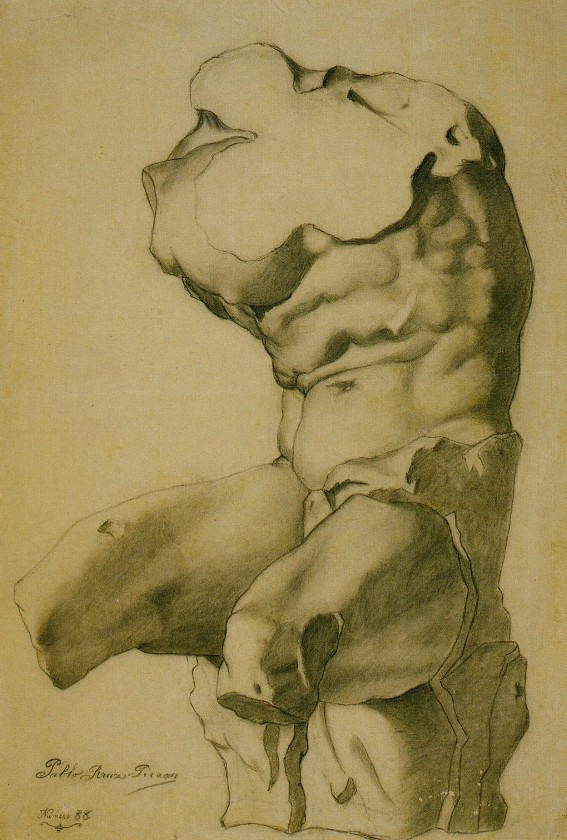
Yes the drawing above is indeed a Picasso!
For the untrained eye, skill in the visual arts is judged by the ability of the artist to make his/her drawing or painting look real. True it requires a great deal of observational skills to make something look right. There is perspective, proportions, chiaroscuro and composition as well as many other things to worry about. These difficulties are why most art schools teach realism first and work their way outwards from there. Quite simply put realism allows the teacher to judge how his or her students are doing.
It takes quite a while to get really good at realism.
Every artist struggles with it. Even the masters have to erase and make changes to make things look right.
Don’t get discouraged if you don’t get it right. It just takes time and practice.
What many artists have yet to learn is that it takes even more skill to work in non-figurative ways. True, there are a lot of people who jump the gun and go straight to abstraction or expressive work without first learning how to successfully work realistically. Their lack of skill is usually easy to spot because they also fail to take the time to learn how to use their materials, which is a topic for another day.
Every single time that I show one of Picasso’s early drawings or paintings, it changes my students’ appreciation of him as an artist. The most common question I hear from people is, why pray tell, did he give up realism?
The fact of the matter is he never did give up realism completely. Like many artists, he usually did start off a body of work with some form of realism.
Like most serious artists, he moved past realism by exploring his creativity through experimentation. His progress was natural, and beyond drawing and painting, he also tried his hand at sculpture, printmaking, and ceramics, to name a few.
As I have always said, not everything Picasso created can be considered great; however, his work is always interesting. The sheer volume of his output is staggering, to say the least, with some estimates coming in at over 250,000 works of art created in his lifetime. If we take a segment of his work across days, months, and years, we can quite literally see his thoughts and ideas forming before our very eyes. One work leads us to another.
Without knowing the artist’s previous skills, most are very dismissive of the artist’s work in general.
There is nothing wrong with any kind of art. We can appreciate every kind of art, but the great thing is that we don’t have to like it. We do need to try and understand it, though. This is so important in our development as artists. We must keep an open mind!
Learning to appreciate art is a skill, and learning to appreciate art in context is a skill.
This is why I encourage everyone, at the very least, to take a general art history class. It will open your mind and horizons to different forms of expression, both of our own and those of other cultures.
Don’t allow yourself to become to set in your ways. Let yourself be open to every kind of art. You may be missing something if you don’t!
.